Editor’s note: The following excerpt from Let Me Be Frank: The Extraordinary Life and Music of Frank Sinatra, Jr. (University Press of Mississippi), co-authored by JazzTimes contributor Bruce Klauber with Andrea Kauffman, is excerpted here by permission: Copyright © 2025 Bruce H. Klauber and Andrea Tamburino.
The Start of Something Big
In the mid-1980s, Andrea Kauffman co-founded Oreo Productions, an Atlantic City-based talent agency that booked most of the jazz acts that came to town, including Mel Tormé, George Shearing, Frank D’Rone, Johnny Hartman, Chris Connor, Billy Daniels, Buddy Greco, Morgana King, and Bobby Scott. On one evening in 1985, in Elaine’s Lounge within the Golden Nugget Hotel and Casino, Kauffman’s life and career changed forever. That was the evening when Frank Sinatra came into Elaine’s and asked her to manage his son.
The scene at Elaine’s Lounge in the mid-1980s was electrifying. Frank Sinatra, who had been performing at Atlantic City’s Resorts International, had been wooed by the Golden Nugget’s Steve Wynn to perform at his venue, and he appeared at the Nugget frequently. Andrea Kauffman’s roster of lounge stars were all jockeying for a spot within Elaine’s when Sinatra was working the main room upstairs. The hope was, of course, that Mr. S. and his entourage would come into the lounge after his show to enjoy whoever was on stage. Most of the time, whoever was on stage was an Andrea Kauffman client. On one evening, singer/guitarist Frank D’Rone was on stage, and Kauffman was in the audience to enjoy the show.
Sinatra and his group, which included Don Rickles, Red Buttons, and Jilly Rizzo, came into Elaine’s through the rear entrance and took a seat at a large banquette at the rear of the room. Andrea Kauffman was summoned to join the Sinatra party.
Kauffman remembers the scene vividly:
Frank Sinatra asked me to book his son. I told him that I hadn’t seen Frankie since 1967. I was happy and confident enough in my business, and in my business sense, not to be swayed just because Frank Sinatra asked. Sure, there was a part of me that said, “Oh my God, this is Frank Sinatra I’m sitting next to.” On the other hand, I’d been working with some very heavy hitters. Okay, it was Frank Jr., his son, but I didn’t know what his show was about, how he sang, or how he was to work with, so I hesitated. Rickles was looking at me and shaking his head. But I think Mr. Sinatra respected my hesitation because he respected who I had booked in that room. I told him that I needed material on Frank Jr. and that I had to hear something he recorded.

He said, “Okay, call my office, and tell Dorothy to send you whatever you need.” What surprised me most was the lack of confidence Mr. S. had in Frankie’s longtime manager and responsible agent, Vinnie Carbone. When I asked Sinatra about that, he said, “Do you see Frankie in Atlantic City?”
I think that’s when Red Buttons finally said something. With his finger pointed to the ceiling, he said, “Ah ha!”
I had a lot of thinking to do. I decided to get in touch with Dorothy Uhlemann and ask for a press kit. And how dare I ask for a press kit on the old man’s son! I got two cassettes and two LPs, It’s Alright and Spice. The tapes were live, and the sound was horrible. I thought, “What the hell is he singing? What is this?”
I called Dorothy, and I asked, “What happens to my career if I send this back?” She cracked up. We had a very candid conversation, and she said, “You do whatever your heart tells you to do.”
I said, “I’ve got to see him. The records don’t mean a thing. What does his live show sound and look like?”
In 1985, casino gambling in Atlantic City had been legal for seven years. Given the shore’s proximity to Philadelphia and New York, Atlantic City became a year-round mecca for day trippers, many of them senior citizens, who came to the resort on buses to play the slots, enjoy a buffet lunch, and perhaps enjoy an afternoon show, presented and produced especially for them. Under Carbone’s management, Frank Jr. had yet to appear in post gaming Atlantic City. He had, of course, appeared with the Dorsey ghost band at the Steel Pier years before.
Carbone came to Atlantic City, as he had set up a meeting with the bookers of the long-defunct Playboy Hotel and Casino, later named the Atlantis Hotel and Casino. He wanted Kauffman to come along because she knew the Playboy management and had booked the venue previously. Playboy wanted to present Frank Jr. with the Rick Szabo Orchestra for a bunch of afternoon shows that catered to the bus crowd, but Carbone wasn’t making any headway. Kauffman decided to come along. In casual conversation along the way, Carbone spoke of Frank Jr.: “He may not sing the songs you want to hear,” he told Kauffman. “And don’t compare him to his father.”
At the meeting, Kauffman found that Carbone was asking for something close to $25,000 per week. “Who’s going to pay that much for Frank Sinatra, Jr. in 1985?” asked Kauffman.
In the end, Frank Jr. took $5,000 a week, which included a couple of rooms. “Frankie doesn’t need the f—- money,” Carbone said. Sinatra concurred, saying, “It’s not about the money.”
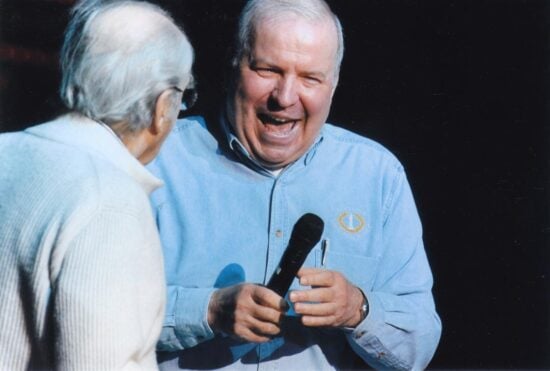
Kauffman still hadn’t heard him in person, so Carbone and Frank flew her out to the Four Queens Hotel and Casino in downtown Las Vegas, where Frank worked frequently. It was right before Kauffman’s 35th birthday, and in the midst of a meeting with Carbone, Frank, and Carbone’s wife at a restaurant called Hugo’s, Frank asked to be excused. Then out of nowhere, there was Frank and all his musicians singing “Happy Birthday” to Andrea. Frank gave her a box, which contained a Four Queens jacket, with the Four Queens logo on one side and Frank Sinatra Jr.’s name on the other. She was impressed. She was being wooed.
She enjoyed the show, though she didn’t love the idea of Frank singing and conducting a 17-piece big band. “You look like you’re making pizza up there,” she said to him. Musically, she did like the show and Frank’s singing, but she wondered why he wasn’t doing more of his father’s material and singing many unusual songs. His answer was, “I’m not my father.”
“Then why would you go into the same business?” she asked. “What are you thinking? If your name was Eric Gold, would anybody book you? Because I know ten acts that I would book before you.”
He said, “Let me do the Playboy dates, and I’ll see what I can do. Come in, and we’ll talk some more.” It finally transpired that he was booked three more times at the Playboy. The weekday afternoon shows were always mobbed, and the day trippers went away happy.
Kauffman was fine with the good business he did but was concerned about the voice itself. She went to jazz singer Morgana King, who had finished her engagement at Elaine’s and was living at Kauffman’s house. “I needed her opinion,” said Kauffman. “She came into the Playboy with me, and her comment was, ‘He’s certainly not his father, is he?’ Kauffman asked her to take that out of the equation and then come up with a judgment. King said, “He’s a decent singer who needs work.”
Andrea Kauffman was getting drawn in. “I loved Vinnie, but I didn’t like the way he was handling Frank,” she said. “I saw a young man there that desperately wanted to be good and desperately needed approval. He loved the music, and he wanted this. It was the first time that my managerial instincts just stood at attention and said to me, ‘If you work with him, there’s a possibility that he’ll go where I think he belongs.’ I gave myself five years to finesse him to the point where he realized the potential that I thought he had.”
Vinnie Carbone didn’t give Kauffman a lot of encouragement, telling her, “There’s no reasoning with this man. You’re not going to get it out of him.”
Kauffman pulled no punches in her reply: “Then in five years, if he can’t pull it all together, I say goodbye. Then either he does it or he doesn’t. It’s a plan. It’s a mind thing.”

The issue was repertoire, and it was something that remained an issue for years to come. Though audiences paid to see a “Sinatra,” Frank Jr. simply did not want to perform the songs made famous by his father. Those who saw him may have been entertained and may have walked out of the theater smiling, but some audiences were confused. You can’t blame them for asking, “Where is ‘My Way,’ and where is ‘The Summer Wind?’ Instead, audiences got one or two Sinatra obscurities at the end of the show.
Postscript: Andrea Kauffman managed Frank Sinatra, Jr. until the day of his passing on March 16, 2016. By that point, he was singing the songs of his father and was performing at the world’s most famous concert halls and jazz clubs. JT